VALUEODDSAPI / DEVELOPER RESOURCES
What is value betting? Meaning, formula and examples
Value betting means betting only when the odds pay more than the outcome is really worth. This guide explains the idea in plain terms, works through one market with real numbers and shows what it takes to do it at scale.
Published by ValueOddsAPI · 3 November 2026
In 30 seconds
- What it is: a value bet is a price that is higher than the true chance of the outcome justifies.
- How you spot it: estimate a fair probability, usually from a sharp bookmaker with the margin removed, and compare every price with it.
- The formula: EV = odds × fair probability − 1. Anything above zero is value; most bettors set a threshold such as +2%.
- The catch: edges are small and results swing. You need hundreds of bets, fresh odds and a fixed staking rule before the numbers mean anything.
New to odds data? Five terms first
- Value bet
- A bet where the odds pay more than the fair probability says they should.
- Implied probability
- 1 ÷ decimal odds. 2.00 implies 50%, 1.95 implies 51.3%.
- Fair probability
- Your best estimate of the true chance, with the bookmaker margin removed.
- Expected value (EV)
- The average return per unit staked if you could repeat the bet many times.
- Sharp bookmaker
- A bookmaker with low margins and high limits whose prices react fast to information.
What is value betting?
Value betting means only betting when the odds are better than the real probability of the outcome. It does not mean betting on the team you think will win. A heavy favourite at 1.30 can be a bad bet, and an outsider at 6.00 can be a good one. What matters is the gap between the price and the probability.
Every bookmaker builds a margin into its prices, so most prices are slightly too short. But bookmakers do not all move at the same speed, and they do not all agree. When one bookmaker is slow to react or simply prices a market differently, its odds can end up above the fair price. That price is a value bet.
If you came here from poker: a value bet at the poker table is a bet made with a strong hand to get called by a weaker one. In sports betting the term means something different, and this guide is about the sports version.
A worked example
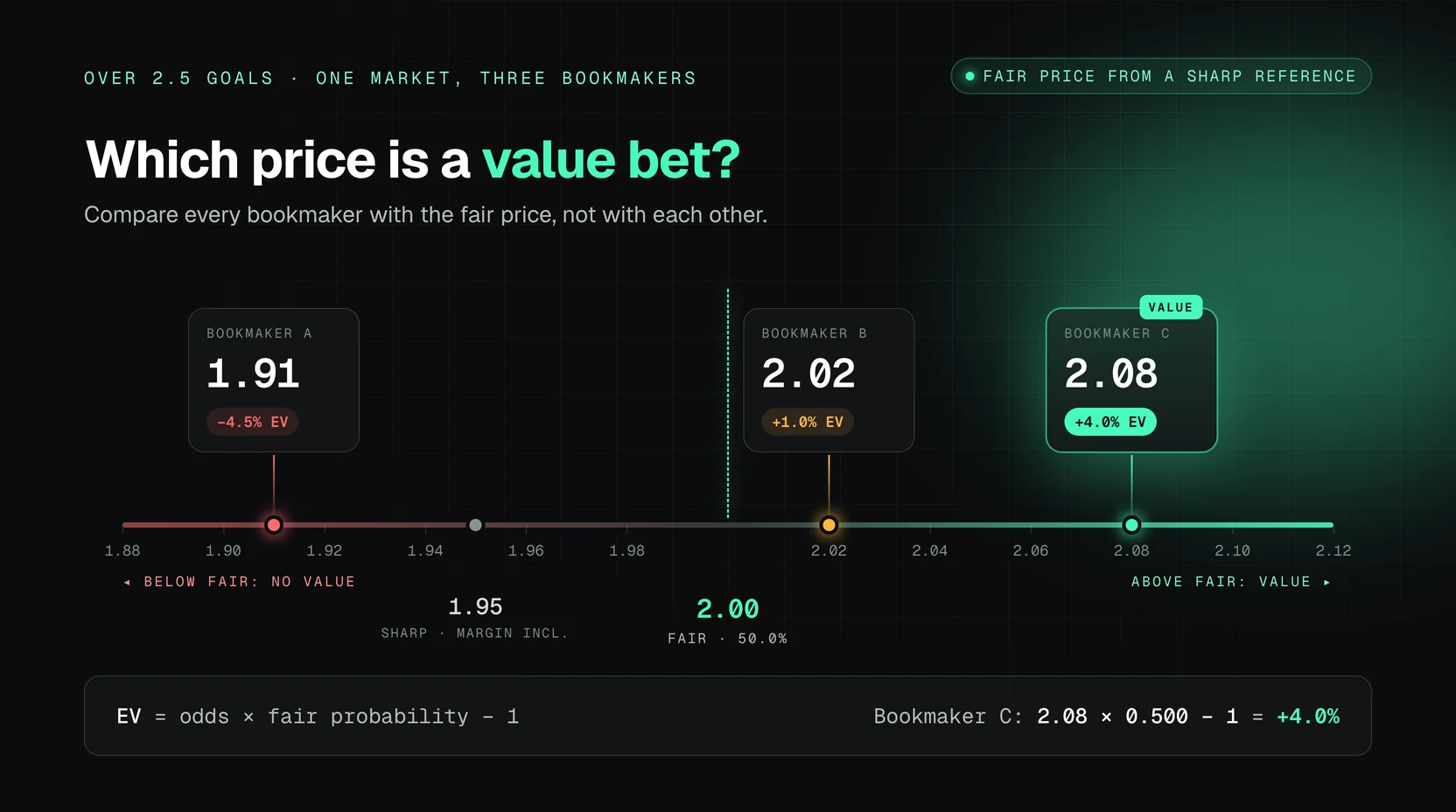
Take one market: Over 2.5 goals in a football match. A sharp bookmaker offers 1.95 on both Over and Under. The implied probabilities add up to 1/1.95 + 1/1.95 = 102.6%, so 2.6% of that is margin. Remove it and each side has a fair probability of 50.0%, which is a fair price of 2.00.
Now compare three other bookmakers with that fair price, not with each other:
| Bookmaker | Odds | Implied probability1 ÷ odds | Expected valueodds × 0.500 − 1 | Verdict |
|---|---|---|---|---|
| Bookmaker A | 1.91 | 52.4% | −4.5% | No value |
| Bookmaker B | 2.02 | 49.5% | +1.0% | Thin |
| Bookmaker C | 2.08 | 48.1% | +4.0% | Value |
Bookmaker C pays 2.08 for something that should pay 2.00. Over many bets like this you would expect to make about 4 cents per unit staked.
Where the fair probability comes from
The whole method stands or falls on the fair probability. There are three common ways to get it, and many bettors combine them.
| Source | How it works | Accuracy | Watch out for |
|---|---|---|---|
| A sharp bookmaker | Take a low-margin price, such as Pinnacle, and remove the margin. | High | You need that exact market and line, captured at the same moment. |
| Market consensus | Remove the margin from many bookmakers and average the result. | Medium | Slow or soft bookmakers drag the average towards their own errors. |
| Your own model | Predict the probability from team data, ratings or player stats. | Varies | Models are often overconfident. Test them against the closing line first. |
See how the margin is removed in How to remove the bookmaker margin, and why sharp prices are used as a reference in Pinnacle odds API.
How value betting works, step by step
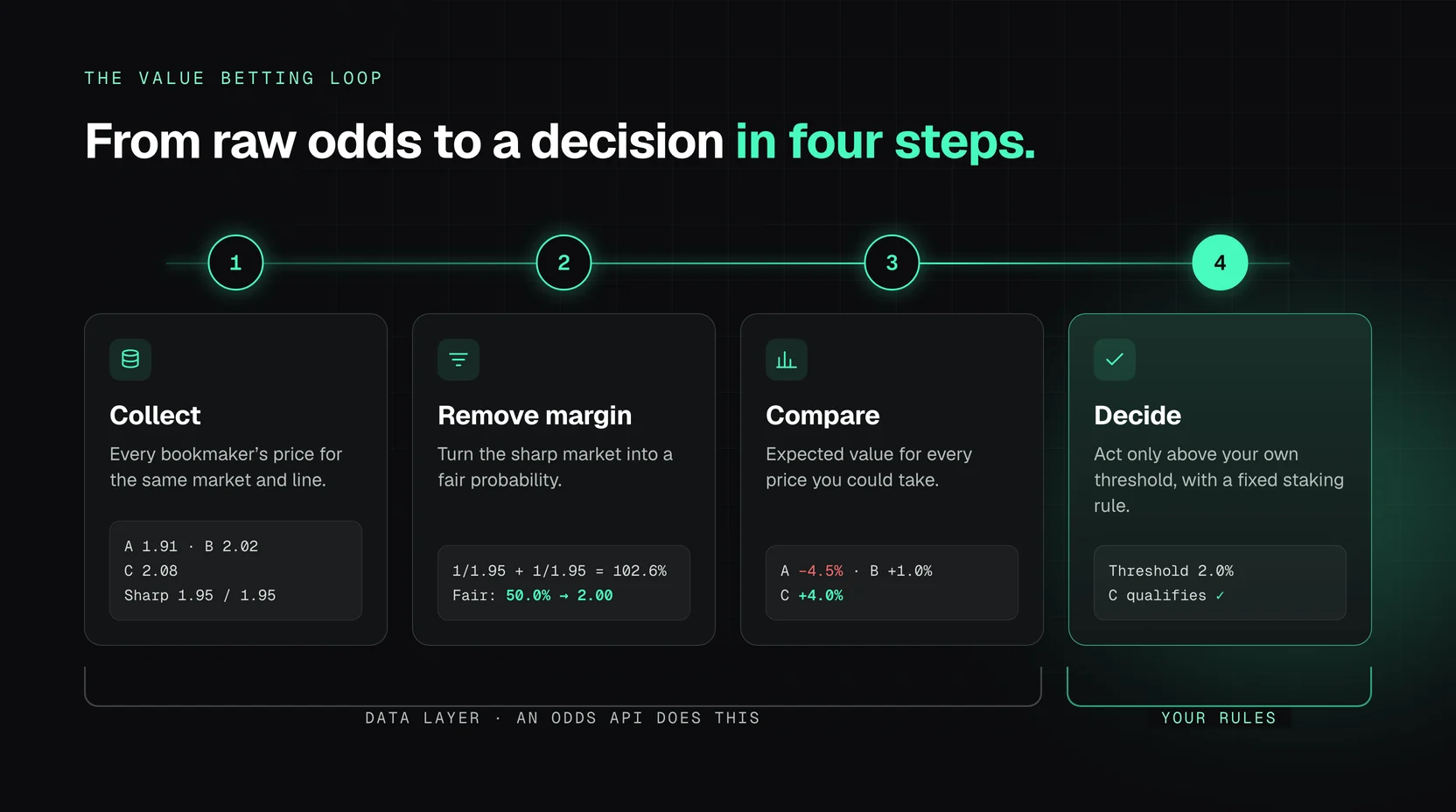
1. Collect. Get every bookmaker’s price for the same event, market and line. Over 2.5 must be compared with Over 2.5, not with Over 2.75.
2. Remove the margin. Turn the reference market into fair probabilities. The proportional method is the simplest; other methods treat favourites and outsiders differently.
3. Compare. Calculate the expected value of every price. Prices are only comparable if they are fresh, so keep track of how old each one is.
4. Decide. Bet only above a threshold you set in advance, for example +2%, and size each stake with a fixed rule such as a flat stake or a fraction of the Kelly criterion.
Steps 1 to 3 are where most of the work is, because they have to run across hundreds of bookmakers and thousands of markets every few seconds. That is what an odds API is for. ValueOddsAPI returns each bookmaker’s original price together with its margin-free fair price and the age of the observation, in one structure, so your code can go straight to step 4. Read more on the value betting API page, or follow the full method in How to find value bets.
Value betting compared with arbitrage and matched betting
| Value betting | Arbitrage betting | Matched betting | |
|---|---|---|---|
| Idea | Take prices above the fair price | Back every outcome at different bookmakers | Use free bets and bonuses, hedged on an exchange |
| Profit per bet | Uncertain, positive on average | Locked in, usually 1–3% | Locked in, from the bonus |
| Variance | High | Very low | Very low |
| Can scale | Yes, many markets | Limited by few opportunities | Ends when bonuses run out |
| Data needed | Odds from many bookmakers plus a fair reference | Fast odds from many bookmakers | Bookmaker offers and exchange prices |
All three get accounts limited eventually. Arbitrage is usually spotted fastest, because the bets look unusual. Full comparison, with a worked arbitrage: Value betting vs arbitrage.
Is value betting profitable?
In theory, yes: if your fair probabilities are right, positive expected value turns into profit over time. In practice, three things decide whether it works.
Variance. Even with a real edge, results swing a lot. The table below shows the same +4% bet at 2.08 repeated with a flat 1-unit stake. The numbers follow from the maths, not from a backtest.
| Bets placed | Expected profitunits | Typical swing± 1 standard deviation | Chance of being down |
|---|---|---|---|
| 100 | +4 | ± 10 | 38% |
| 500 | +20 | ± 23 | 20% |
| 1,000 | +40 | ± 33 | 11% |
| 2,000 | +80 | ± 47 | 4% |
Odds 2.08, fair probability 50%, flat stake of 1 unit, exact binomial calculation.
Accurate fair prices. If your reference is wrong, the edge is not real. The standard check is closing line value: if you consistently beat the closing price, your fair probabilities are probably good. CLV gives an answer after a few hundred bets, long before profit and loss do.
Limits. Soft bookmakers restrict accounts that win consistently. That caps how much you can stake and is the main practical limit of value betting.
More numbers, drawdowns and what a month can look like: Is value betting profitable?
Common mistakes
Comparing stale prices. A price from 30 seconds ago may already be gone. Always check when each price was observed.
Mixing lines and rules. Asian handicap −0.25 and −0.5 are different bets, and some bookmakers settle player props differently when a player does not start.
Forgetting the margin. Comparing a soft price with a sharp price that still contains its margin underestimates your edge on some bets and invents edges on others.
Staking too big. Full Kelly staking with an uncertain edge leads to large drawdowns. Most bettors use a quarter or half of it, or a flat stake.
Judging too early. Fifty bets say almost nothing. Track CLV and expected value per bet, and judge after hundreds.
Frequently asked questions
What does value betting mean?
It means betting only when the odds are higher than the fair probability of the outcome justifies. You compare the price with a fair price instead of guessing who will win.
How do you calculate a value bet?
Multiply the decimal odds by your fair probability and subtract 1. At odds of 2.08 and a fair probability of 50%, 2.08 × 0.50 − 1 = +4%. A positive number is a value bet.
Is value betting legal?
Value betting is simply choosing which bets to place, so it is legal wherever sports betting is legal for you. Bookmakers are allowed to limit or close accounts that win, which is why value bettors spread their action across many bookmakers. This is not legal advice.
What is a good EV threshold for value bets?
Many bettors use somewhere between +1% and +5%. A higher threshold gives fewer bets but more room for errors in your fair price. Pick one in advance and test it with closing line value.
Can I find value bets without a model?
Yes. The most common approach does not use a model at all: it uses a sharp bookmaker, with the margin removed, as the fair price and looks for softer bookmakers that are slower to move.
Do I need an odds API for value betting?
For a handful of bets a day you can compare prices by hand. To scan many bookmakers and markets continuously, you need structured, fresh odds data, which is what an odds API provides.
Related reading
ValueOddsAPI provides odds data, not betting advice. Betting involves risk of loss and is for adults (18+) only. If gambling stops being fun, contact your local support service, such as StopSpillet in Denmark.
Get the data into your product
Solo €899/month (personal use), Pro €1,800, Scale €4,000, Elite €8,000 and Enterprise from €13,000/month, excluding VAT. Coverage and usage rights are confirmed before activation. Missing a bookmaker? We add the sources you need, scoped and priced per project.