VALUEODDSAPI / DEVELOPER RESOURCES
Is value betting profitable? The honest numbers
Value betting is profitable on paper, but the edge is small and luck dominates for a long time. This guide puts numbers on it: how many bets it takes, what a month can look like and what usually stops it from working.
Published by ValueOddsAPI · 3 November 2026
In 30 seconds
- Short answer: yes, value betting is profitable in the long run, but only if your fair prices are accurate and you can keep getting bets on.
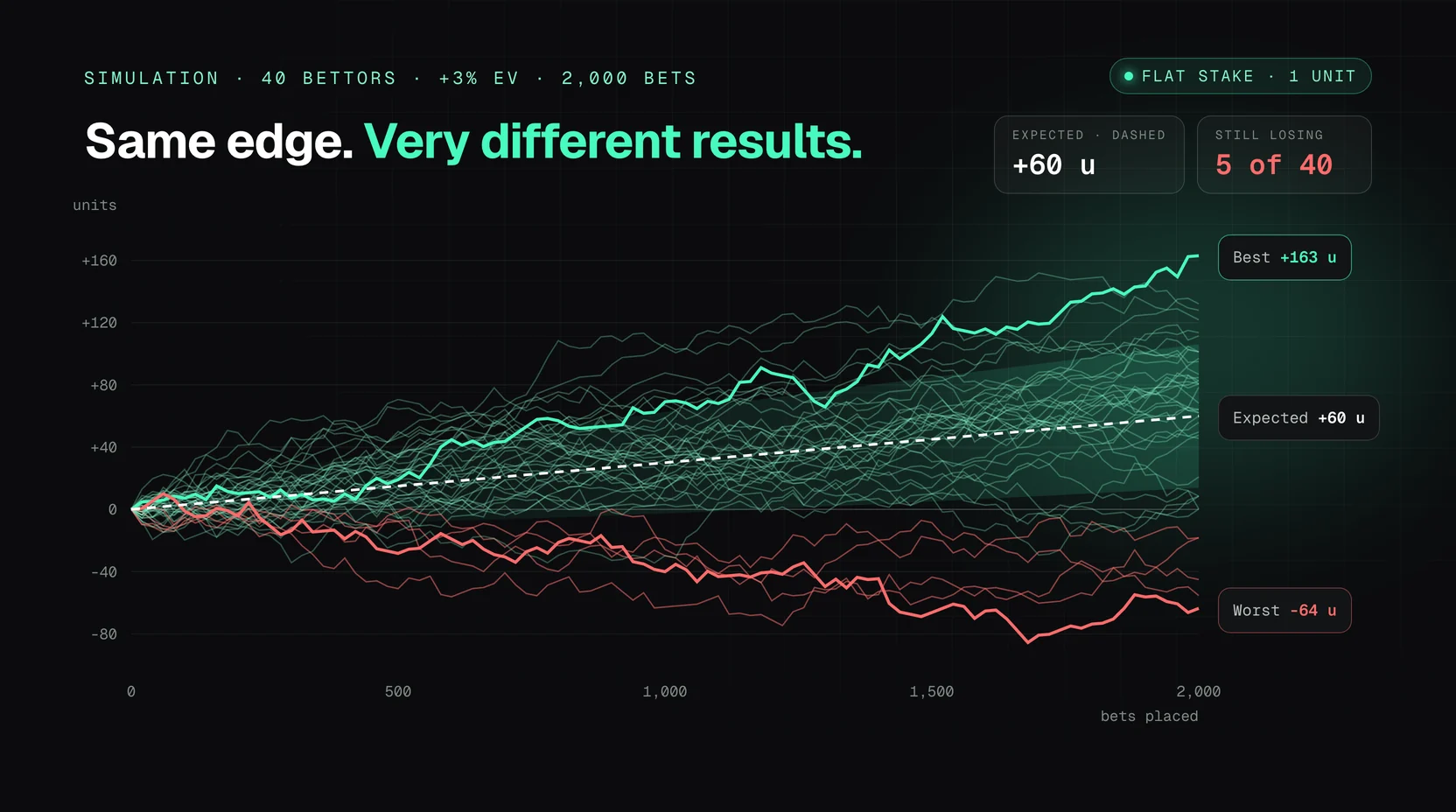
- Variance is huge: with a +3% edge, about 1 in 5 bettors is still losing after 1,000 bets, and almost 1 in 10 after 2,000.
- How much: expected profit is turnover × edge. $10,000 a month staked at +3% is about $300 a month, with big swings either way.
- What usually stops it: account limits at soft bookmakers, not the maths.
The short answer
Value betting is profitable for the same reason a casino is: every bet has a small positive expected value, and over enough bets the average wins. The difference is that you are the one with the edge, and the edge is small. Most real value bets are worth somewhere between 1% and 5% of the stake.
So the honest answer has three conditions. It works if your fair probabilities are right, if you place enough bets for the edge to show, and if bookmakers keep accepting your bets at a useful size. Miss any one of them and the profit disappears.
New to the idea? Start with What is value betting?
Why the maths works
Expected value is the average result per bet if you could repeat it forever: EV = odds × fair probability − 1. A bet at 2.06 on something with a true 50% chance has an EV of +3%. Win, and you get +1.06 units; lose, and you lose 1 unit. Half the time each, that averages +0.03 units per bet.
Any single bet is still a coin flip. The +3% only becomes visible when hundreds or thousands of these bets are added together, and that is where most people give up too early.
Variance: how long until the edge shows
The chart at the top of this page shows 40 simulated bettors with exactly the same +3% edge and the same flat stake. After 2,000 bets the best is up 163 units and the worst is down 64. Nothing differs between them except luck. The table below gives the exact chance of still being down, for different edges and numbers of bets.
| Edge per bet | 250 bets | 500 bets | 1,000 bets | 2,000 bets | 5,000 bets |
|---|---|---|---|---|---|
| +1% | 43% | 41% | 39% | 34% | 24% |
| +2% | 38% | 34% | 27% | 19% | 8% |
| +3% | 33% | 25% | 18% | 9% | 2% |
| +5% | 24% | 15% | 7% | 2% | <0.1% |
Exact binomial calculation: odds around 2.00, fair probability 50%, flat stake. Longer odds swing more and need even more bets.
Drawdowns are normal
Even when the edge is real, the path is not smooth. In 10,000 simulated runs of 2,000 bets at +3% with a 1-unit flat stake, the median worst drop from a previous high was 36 units, and one run in ten had a drop of 58 units or more.
That is why most value bettors keep a bankroll of at least 100 stakes and size bets at 1% of it or less. A losing month is not evidence that the method is broken. A long run of negative closing line value is.
How much can you make?
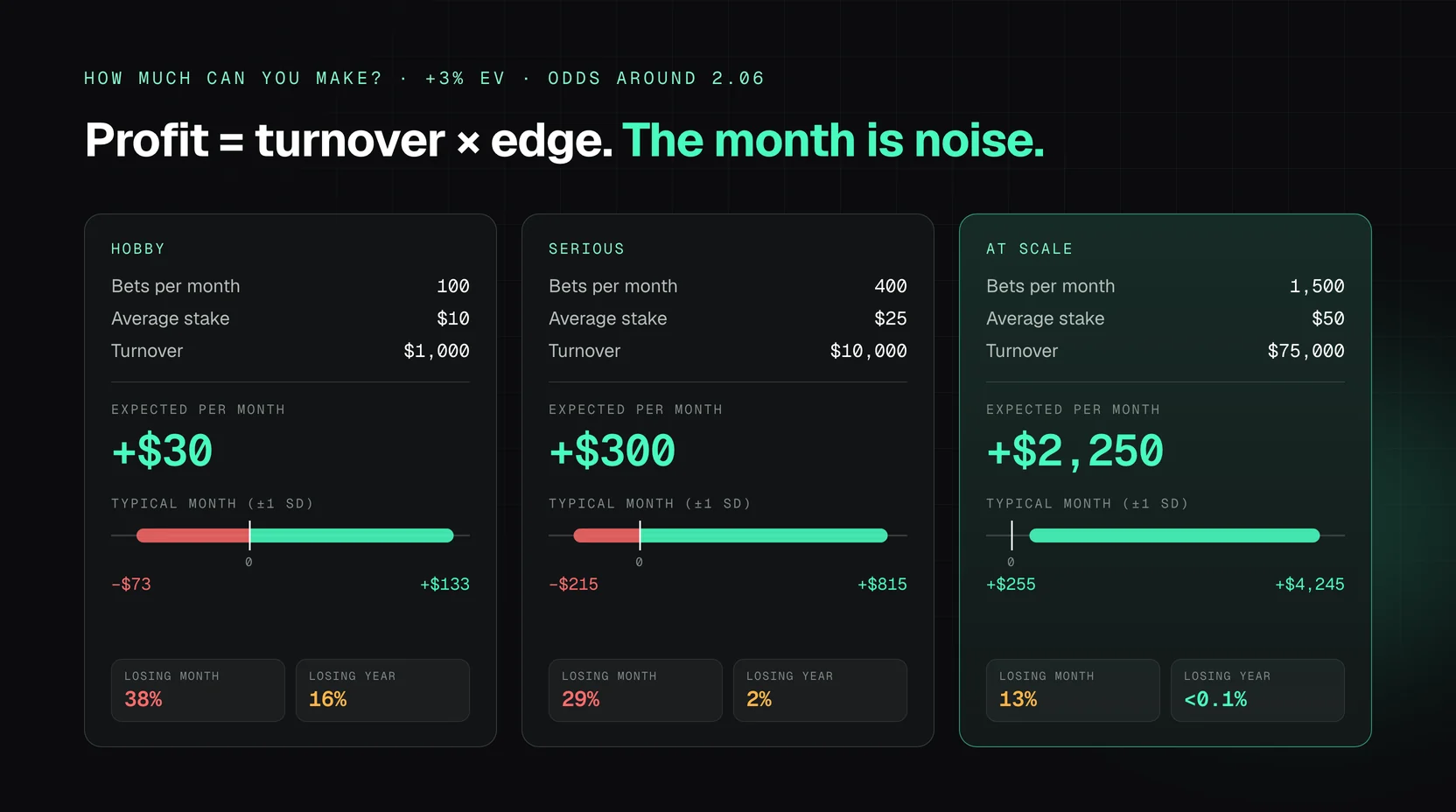
The formula is simple: expected profit = turnover × average edge. Turnover is the total amount you stake. At a +3% average edge:
| Profile | Turnover per month | Expected per month | Typical month± 1 standard deviation | Losing month | Losing year |
|---|---|---|---|---|---|
| Hobby: 100 bets × $10 | $1,000 | +$30 | −$73 to +$133 | 38% | 16% |
| Serious: 400 bets × $25 | $10,000 | +$300 | −$215 to +$815 | 29% | 2% |
| At scale: 1,500 bets × $50 | $75,000 | +$2,250 | +$255 to +$4,245 | 13% | <0.1% |
Calculated for odds around 2.06 and a fair probability of 50%. Assumes the edge is real and every bet is accepted at full stake.
Two things follow. Small stakes make very little money even with a real edge, so value betting is mainly worth it when you can place a lot of volume. And volume is exactly what soft bookmakers try to stop, which brings us to the real limit.
What actually kills the profit
| Problem | What happens | What you can do |
|---|---|---|
| Account limits | Soft bookmakers cut maximum stakes for winning accounts, sometimes to a few dollars. | Spread bets over many bookmakers and markets; accept that accounts have a lifetime. |
| Wrong fair prices | The reference is stale or the market is thin, so the “edge” is not real. | Use a sharp reference for the exact market and track closing line value. |
| Stale odds | The price is gone or cut by the time you click. | Use fresh data and skip prices older than a few seconds. |
| Overstaking | A drawdown wipes out the bankroll before the edge shows. | Flat stakes or fractional Kelly, with a bankroll of 100+ stakes. |
| Costs | Exchange commission, taxes and paid tools eat into a small edge. | Count them per bet and raise your EV threshold to cover them. |
How to tell if it is working
Because profit and loss take thousands of bets to settle down, value bettors judge their process by two faster signals:
Closing line value. If the price you took is regularly better than the last price before kick-off, your fair prices are good. CLV gives a reliable answer after a few hundred bets. See Closing line value (CLV).
Expected versus actual profit. Add up the expected value of every bet you place and compare it with your real result. Over time the two should meet. If actual profit runs far below expected for a long time, check your reference and your data before blaming luck.
Is value betting worth it?
| Probably worth it | Probably not worth it | |
|---|---|---|
| Time | You can follow prices daily or automate it. | You want to bet a few times a week. |
| Stakes | You can stake enough for +3% to matter. | Stakes are small, so expected profit is a few dollars. |
| Temperament | You can sit through months of losses with a positive CLV. | A losing month makes you change the method. |
| Tools | You have fresh odds from many bookmakers and a fair reference. | You compare prices by hand from a few sites. |
Frequently asked questions
Is value betting profitable in the long run?
Yes, if your fair probabilities are accurate and you place enough bets. Positive expected value turns into profit over a large sample, but with a typical edge of 1–5% that sample is usually thousands of bets.
Does value betting really work?
The maths is sound and it is how professional bettors and trading teams think about prices. Whether it works for you depends on the quality of your fair prices, your discipline and how long your accounts stay open.
How much money can you make value betting?
Roughly your total turnover multiplied by your average edge. Staking $10,000 a month at +3% gives an expected $300 a month, but any single month can easily be negative.
How many bets until I know if it works?
Profit and loss need thousands of bets. Closing line value gives a useful answer after a few hundred, so track it from the first bet.
Do bookmakers ban value bettors?
Soft bookmakers often limit the maximum stake of accounts that win consistently. Sharp bookmakers and exchanges generally accept winning players, but their prices are harder to beat.
Is value betting legit or a scam?
The method is legitimate. Be careful with services that promise guaranteed or fixed monthly profits: no value betting method can guarantee a result, because each bet can still lose.
Related reading
ValueOddsAPI provides odds data, not betting advice. Betting involves risk of loss and is for adults (18+) only. If gambling stops being fun, contact your local support service, such as StopSpillet in Denmark.
Get the data into your product
Solo €899/month (personal use), Pro €1,800, Scale €4,000, Elite €8,000 and Enterprise from €13,000/month, excluding VAT. Coverage and usage rights are confirmed before activation. Missing a bookmaker? We add the sources you need, scoped and priced per project.