VALUEODDSAPI / DEVELOPER RESOURCES
Value betting vs arbitrage (and matched betting)
Arbitrage locks in a small profit, value betting chases a bigger expected one, and matched betting lives off bonuses. This guide compares the three on the same match, works through an arbitrage step by step and shows where each one breaks.
Published by ValueOddsAPI · 3 November 2026
In 30 seconds
- Arbitrage: back every outcome at different bookmakers so you win the same amount whatever happens. Small, certain profit, usually 1–3%.
- Value betting: back only the side that is priced above its fair value. Bigger edge on average, but each bet can lose.
- Matched betting: turn bookmaker free bets into cash by laying them on an exchange. Certain profit, but it ends when the offers do.
- In practice: arbitrage gets accounts limited fastest. Value betting scales furthest, if you can live with the variance.
New to odds data? Five terms first
- Arbitrage (arb)
- Prices at different bookmakers that add up to less than 100%, so backing all outcomes locks in a profit.
- Value bet
- A single price above the fair price of the outcome.
- Matched betting
- Placing a bookmaker bet and the opposite lay bet on an exchange to extract a bonus.
- Book percentage
- The implied probabilities of all outcomes added up. Above 100% is margin, below 100% is an arb.
- Palpable error
- An obvious pricing mistake. Bookmakers may void bets placed at such prices.
The difference in one paragraph
All three methods use the same raw material, the prices of many bookmakers, but they use it differently. Arbitrage looks for two or more prices that together cost less than 100% and backs all of them. Value betting looks for one price that is too high compared with the fair price and backs only that. Matched betting ignores prices that beat the market and instead uses bookmaker offers, hedged on an exchange.
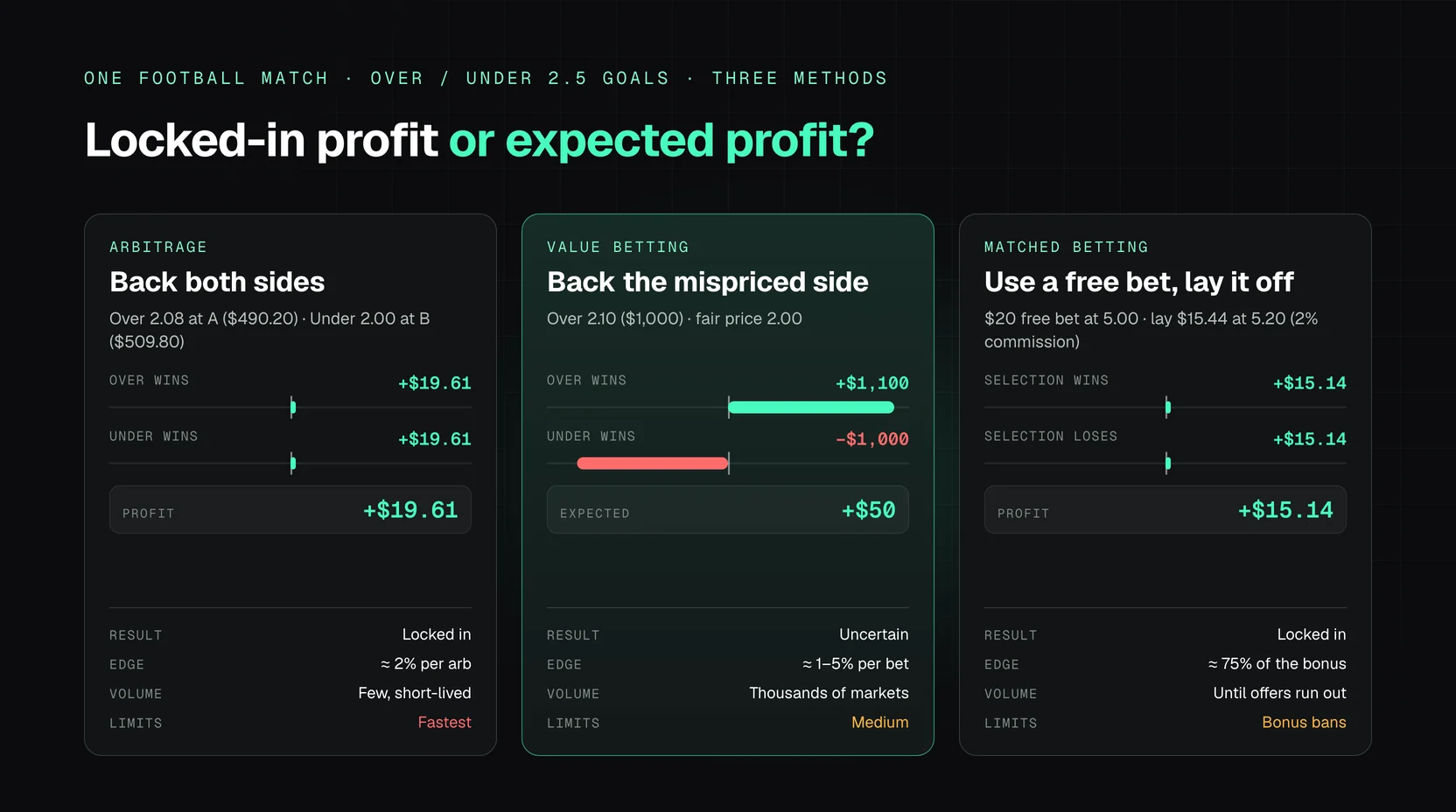
The result: arbitrage and matched betting give a known profit per bet, while value betting gives an expected profit that only shows up over many bets. The comparison at the top of this page puts the three side by side on the same match.
How arbitrage betting works
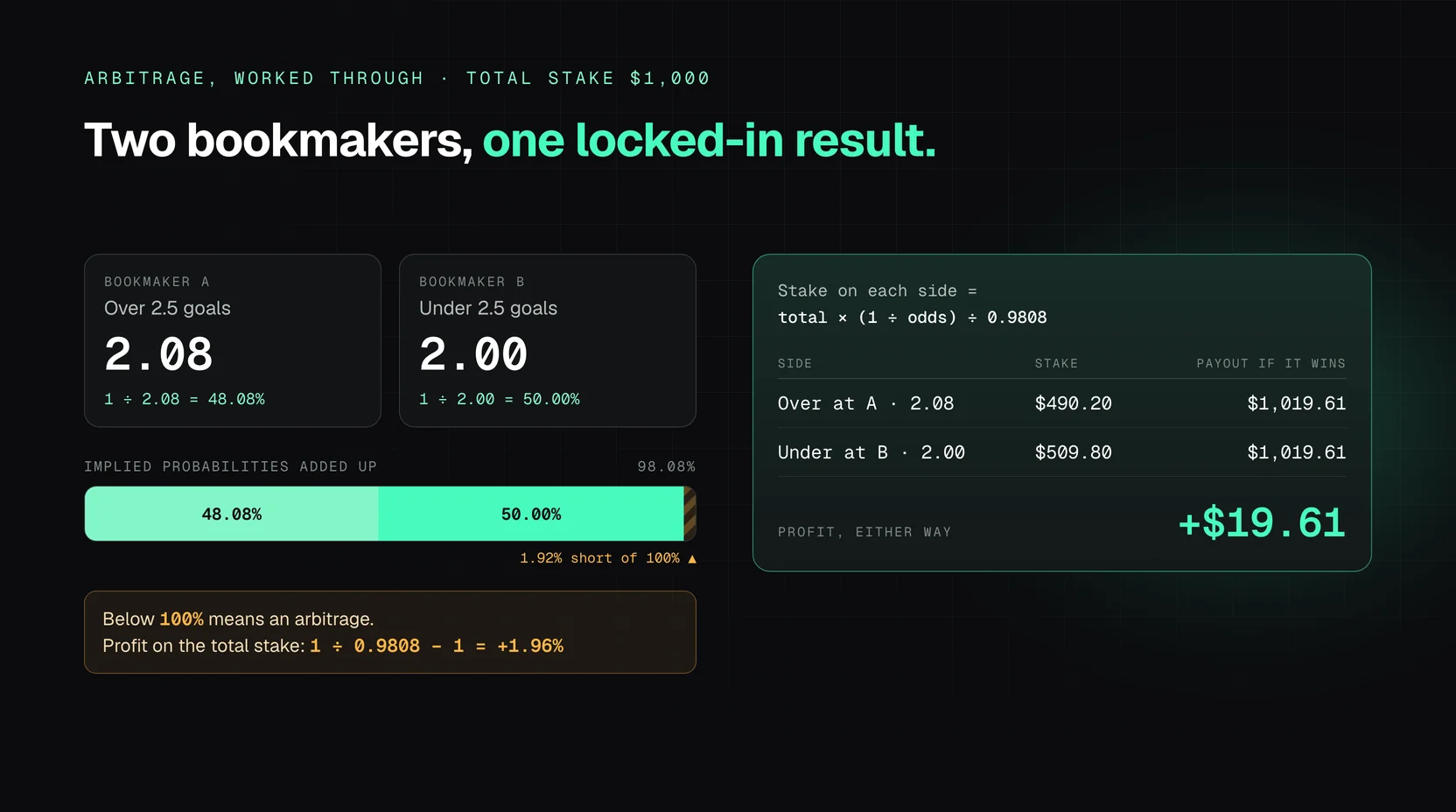
Turn each price into an implied probability with 1 ÷ odds and add them up. Over 2.5 at 2.08 is 48.08% and Under 2.5 at 2.00 is 50.00%, a total of 98.08%. Because the total is below 100%, backing both sides guarantees a profit of 1 ÷ 0.9808 − 1 = +1.96% of the total stake.
To get the same payout whichever side wins, split the stake in proportion to the implied probabilities: stake = total × (1 ÷ odds) ÷ book percentage. With $1,000 that is $490.20 on Over and $509.80 on Under, and either side pays $1,019.61.
def arbitrage(odds, total):
    """Return the locked-in profit and the stake per outcome, or None if there is no arb."""
    book = sum(1 / o for o in odds)          # implied probabilities added up
    if book >= 1:
        return None
    stakes = [total * (1 / o) / book for o in odds]
    return 1 / book - 1, stakes

# Over 2.5 at 2.08 (bookmaker A), Under 2.5 at 2.00 (bookmaker B)
profit, stakes = arbitrage([2.08, 2.00], total=1000)
print(f"{profit:+.2%}", [round(s, 2) for s in stakes])   # +1.96% [490.2, 509.8]
How value betting is different
Value betting would take only one of those two bets. If the fair price for Over 2.5 is 2.00 (a 50% chance), then 2.10 is a value bet with an expected value of 2.10 × 0.50 − 1 = +5%. Staking $1,000 returns +$1,100 or −$1,000, and +$50 on average.
There is a useful link between the two: every arbitrage contains at least one value bet. If the prices add up to less than 100% and the true probabilities add up to exactly 100%, at least one price must be above its fair value. Many value bettors therefore treat arbs as a signal and take only the mispriced side.
The full method is in How to find value bets.
Matched betting in brief
Matched betting uses bookmaker promotions. You place the bookmaker’s bet, for example a $20 free bet at 5.00, and lay the same selection on a betting exchange at 5.20. With 2% exchange commission, a lay stake of $15.44 leaves you with +$15.14 whichever way the match goes, about 75% of the free bet’s value.
It is low risk and easy to learn, but the profit comes from bonuses, not from beating prices. Once you have used the offers, or the bookmaker excludes you from promotions, it stops.
Value betting vs arbitrage vs matched betting
| Value betting | Arbitrage betting | Matched betting | |
|---|---|---|---|
| What you bet on | Only the mispriced side | Every outcome, at different bookmakers | A bookmaker offer, hedged on an exchange |
| Profit per bet | Expected 1–5%, not guaranteed | Locked in, usually 1–3% | Locked in, about 70–80% of the bonus |
| Variance | High | Very low | Very low |
| Opportunities | Many | Few, short-lived | As many as the offers |
| How fast you get limited | Medium | Fastest | Bonus bans |
| Capital needed | A bankroll of 100+ stakes | Money spread over many accounts | Small, plus exchange liability |
| Data you need | Fresh odds plus a fair reference | Very fresh odds from many bookmakers | Offers plus exchange prices |
The risks of arbitrage betting
“Risk-free” is only true if both bets are accepted at the prices you saw and settled the same way. In practice:
A price changes before the second bet. You are left with one side at full risk, or you close it at a loss. A bet is voided as a palpable error. The other side then stands alone. The rules differ. One bookmaker voids a tennis match after a retirement, the other settles it. Limits arrive quickly. Arbs often sit on unusual prices at soft bookmakers, exactly the pattern their risk teams look for. Margins are thin. At 2% per arb, a single mistake can cost the profit of dozens of successful ones.
Which one should you choose?
| If you want… | Choose | Why |
|---|---|---|
| A small, steady start with low risk | Matched betting | Profit is locked in and the method is simple, until the offers run out. |
| Certain profit per bet and fast execution | Arbitrage | No variance per bet, but expect limits and keep capital at many bookmakers. |
| The method that scales furthest | Value betting | Many more opportunities and a bigger edge, in exchange for large swings. |
Read the numbers behind the swings in Is value betting profitable?
The data behind both
Arbitrage and value betting both start with the same thing: the current price of the same market at many bookmakers, in one comparable format. Arbitrage needs that data to be very fresh, because arbs disappear in seconds. Value betting also needs a fair reference price for every market.
ValueOddsAPI returns each bookmaker’s original price, the margin-free fair price and the age of every observation in one structure, so the arbitrage function above and the value bet scanner in How to find value bets can run on the same feed. See the value betting API and the bookmaker catalogue.
Frequently asked questions
Is arbitrage betting legal?
Yes, in most countries where sports betting is legal, because you are simply placing normal bets. Bookmakers are allowed to limit or close accounts and may void bets on obvious pricing errors. This is not legal advice.
Is arbitrage betting worth it?
It can be, but profits are small per bet, opportunities are short-lived and accounts get limited quickly. It works best with fast data, money spread over many bookmakers and careful checks of each bookmaker’s rules.
Which is more profitable, value betting or arbitrage?
Value betting usually has the higher long-run potential, because there are more opportunities and the edge per bet is larger. Arbitrage has no variance per bet but runs into limits sooner.
Can you combine value betting and arbitrage?
Yes. Every arbitrage contains at least one value bet, so many bettors use arbs as a signal and back only the side priced above its fair value, or take full arbs when the accounts allow it.
Why do bookmakers limit arbitrage bettors?
Arbitrage bets are usually placed on prices that are out of line with the market, often just before they are corrected. Bookmakers see that as a sign the customer will win in the long run.
Is matched betting still worth it?
For a beginner it is still a low-risk way to earn from sign-up and reload offers. The income is limited by how many offers you can use, and bookmakers can exclude accounts from promotions.
Related reading
ValueOddsAPI provides odds data, not betting advice. Betting involves risk of loss and is for adults (18+) only. If gambling stops being fun, contact your local support service, such as StopSpillet in Denmark.
Get the data into your product
Solo €899/month (personal use), Pro €1,800, Scale €4,000, Elite €8,000 and Enterprise from €13,000/month, excluding VAT. Coverage and usage rights are confirmed before activation. Missing a bookmaker? We add the sources you need, scoped and priced per project.