VALUEODDSAPI / DEVELOPER RESOURCES
Kelly criterion for betting: formula, examples and calculator
The Kelly criterion tells you how much of your bankroll to stake when you have an edge. This guide explains the formula with decimal odds, shows what full, half and quarter Kelly do to a bankroll, and ends with a small calculator.
Published by ValueOddsAPI · 3 November 2026
In 30 seconds
- The formula: Kelly stake = (odds × p − 1) ÷ (odds − 1), as a share of your bankroll. In words: your edge divided by the net odds.
- Example: odds 2.10 with a fair probability of 50% gives a 5% edge and a full Kelly stake of 4.55% of the bankroll.
- Full Kelly is brutal: in our simulation, 94% of full Kelly bettors saw their bankroll halve at some point. Half Kelly keeps 75% of the growth.
- Biggest risk: Kelly assumes your probability is right. Overestimate the edge and you are overbetting without knowing it.
New to odds data? Five terms first
- Bankroll
- The money set aside for betting, kept separate from everything else.
- Edge
- Expected value per unit staked: odds × fair probability − 1.
- Kelly fraction
- The share of the bankroll the Kelly formula says to stake.
- Fractional Kelly
- Staking a fixed part of the Kelly fraction, usually a half or a quarter.
- Drawdown
- How far the bankroll falls from its previous high.
What is the Kelly criterion?
The Kelly criterion is a staking formula. It tells you what share of your bankroll to bet so that the bankroll grows as fast as possible over the long run. John L. Kelly Jr. published it at Bell Labs in 1956, and it has been used by gamblers and investors ever since.
The idea is simple: bet more when your edge is bigger and the odds are shorter, bet less when the edge is small or the odds are long, and never bet when there is no edge. Because the stake is a share of the current bankroll, stakes shrink automatically during a losing run and grow during a winning one.
Kelly only makes sense once you have an edge. If you are not sure what that means, read What is value betting? first.
The Kelly formula for decimal odds
With decimal odds and a fair probability p, the full Kelly stake as a share of your bankroll is:
f = (odds × p − 1) ÷ (odds − 1)
The top half is your edge (expected value per unit). The bottom half is the net odds, what you win per unit if the bet wins. So the formula is just edge ÷ net odds. You may also see it as f = (b × p − q) ÷ b, where b = odds − 1 and q = 1 − p. It is the same thing.
| Odds | Fair probability | Edge | Full Kellyshare · stake | Half Kellyshare · stake | Quarter Kellyshare · stake |
|---|---|---|---|---|---|
| 2.10 | 50% | +5.0% | 4.55% · $45.45 | 2.27% · $22.73 | 1.14% · $11.36 |
| 2.06 | 50% | +3.0% | 2.83% · $28.30 | 1.42% · $14.15 | 0.71% · $7.08 |
| 3.40 | 31% | +5.4% | 2.25% · $22.50 | 1.13% · $11.25 | 0.56% · $5.63 |
| 1.60 | 64% | +2.4% | 4.00% · $40.00 | 2.00% · $20.00 | 1.00% · $10.00 |
| 1.95 | 50% | −2.5% | No bet | No bet | No bet |
The 3.40 bet has a bigger edge than the 1.60 bet but gets a smaller stake, because long odds lose more often. Where the fair probability comes from: How to remove the bookmaker margin.
Why full Kelly is too aggressive
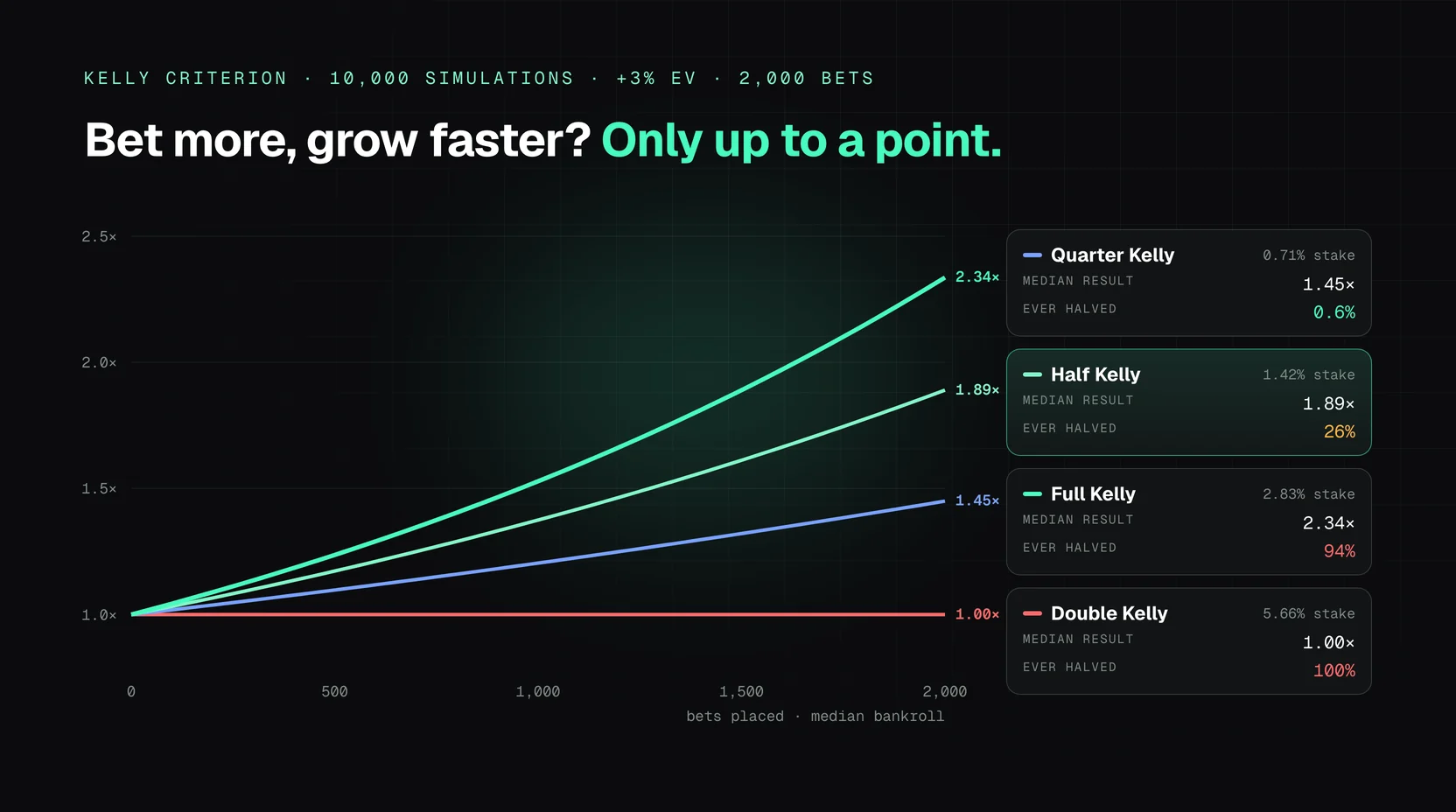
Full Kelly maximises long-run growth, but the ride is violent. We simulated 10,000 bettors placing 2,000 bets each with a +3% edge at odds of 2.06, at four stake sizes:
| Strategy | Stake per bet | Median bankrollafter 2,000 bets | Still below start | Ever halvedat some point |
|---|---|---|---|---|
| Quarter Kelly | 0.71% | 1.45× | 13% | 0.6% |
| Half Kelly | 1.42% | 1.89× | 17% | 26% |
| Full Kelly | 2.83% | 2.34× | 26% | 94% |
| Double Kelly | 5.66% | 1.00× | 51% | 100% |
10,000 simulations per strategy, each bet at 2.06 with a fair probability of 50%, stake recalculated from the current bankroll.
Full Kelly has the highest median, but almost every full Kelly bettor lost half the bankroll at some point along the way. Very few people keep following a method through that. Double Kelly is the worst of both worlds: twice the risk and, in the median, no growth at all.
Fractional Kelly: most of the growth, far less risk
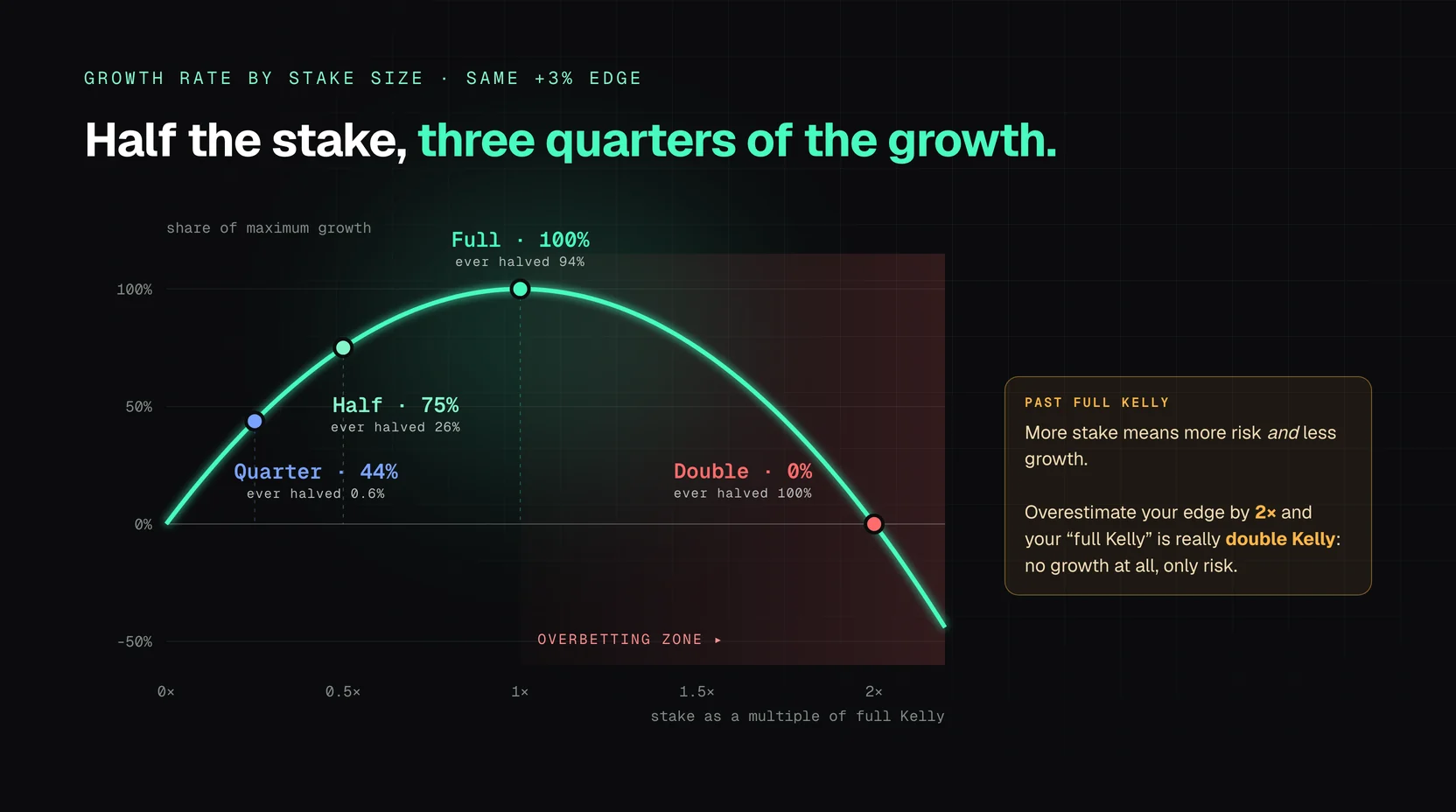
The growth rate rises steeply at first and flattens near full Kelly. That is why fractional Kelly is so popular: half Kelly keeps 75% of the growth while cutting the chance of halving the bankroll from 94% to 26% in our simulation. Quarter Kelly keeps 44% of the growth and almost never halves.
Past full Kelly the curve falls just as steeply. Every extra unit of stake adds risk and removes growth, and at twice the Kelly stake the expected growth reaches zero.
The real danger: your probability is an estimate
Kelly assumes you know the true probability. You never do. If you think a bet at 2.06 has a 50% chance but the true chance is 49%, your real edge is +0.9%, not +3%. Staking full Kelly for a 3% edge is then more than three times the right stake, and the expected growth turns negative: in the median, the bankroll would be down about 27% after 2,000 bets, on bets that really do have a positive edge.
This is the strongest argument for half or quarter Kelly. It builds in a margin for the errors in your fair prices. Check those prices regularly with closing line value, and size down if your CLV is weaker than the edges you think you are getting.
Kelly in practice
Cap the stake. Set a maximum per bet, such as 2–3% of the bankroll, so one big estimated edge cannot dominate. Large edges are more often errors than gifts.
Several bets at once. Kelly is defined for one bet at a time. When many bets run in parallel, size each one from the bankroll at the start of the day and cap the total amount at risk.
Never both sides. Two value bets in the same market, such as Over and Under at different bookmakers, are not independent. Treat them as one position.
Limits come first. Bookmakers often accept less than the Kelly stake. Then the limit, not the formula, sets your stake.
Kelly vs flat staking
| Fractional Kelly | Flat stake | |
|---|---|---|
| Stake | A share of the bankroll that depends on edge and odds | The same amount on every bet |
| Growth | Compounds | Grows in a straight line |
| Sensitive to bad probabilities | Yes | Less |
| Ease of use | Needs a calculation per bet | Very simple |
| Good for | Reliable fair prices and a tracked edge | Starting out, or when edges are uncertain |
A Kelly calculator in Python
This function returns the stake for one bet. It uses half Kelly by default and caps the stake at 3% of the bankroll. Use it with the fair probabilities from your value bet scanner, as in How to find value bets.
def kelly_stake(odds, p, bankroll, fraction=0.5, cap=0.03):
    """Stake for one bet: fractional Kelly, capped at a share of the bankroll."""
    edge = odds * p - 1                  # expected value per unit staked
    if edge <= 0:
        return 0.0                       # no edge, no bet
    f = edge / (odds - 1) * fraction     # Kelly fraction of the bankroll
    return round(bankroll * min(f, cap), 2)

print(kelly_stake(2.10, 0.50, bankroll=1000))               # 22.73 (half Kelly)
print(kelly_stake(2.10, 0.50, bankroll=1000, fraction=1))   # 30.0  (full Kelly, capped at 3%)
print(kelly_stake(1.95, 0.50, bankroll=1000))               # 0.0   (negative EV)
Frequently asked questions
What is the Kelly criterion in betting?
A formula for the share of your bankroll to stake on a bet so that the bankroll grows as fast as possible in the long run. It depends on your edge and the odds.
How do you calculate the Kelly stake?
Kelly stake = (odds × p − 1) ÷ (odds − 1), where p is the fair probability. At odds of 2.10 and p = 50%, that is 0.05 ÷ 1.10 = 4.55% of the bankroll. Half Kelly is 2.27%.
Is the Kelly criterion good for sports betting?
It is a sound way to size bets when you have a real edge, but full Kelly is very volatile and punishes errors in your probabilities. Most bettors use half or quarter Kelly with a maximum stake.
Should I use full Kelly or fractional Kelly?
Fractional Kelly. Half Kelly keeps about 75% of the growth with far smaller drawdowns, and protects you when your edge is smaller than you think.
What if the Kelly formula gives a negative number?
A negative or zero result means the bet has no edge at those odds. The Kelly stake is zero: do not bet.
Can I use Kelly for several bets at the same time?
Yes, with care. Size each bet from the bankroll at the start of the period, cap the total stake at risk, and treat bets in the same market as one position.
Related reading
ValueOddsAPI provides odds data, not betting advice. Betting involves risk of loss and is for adults (18+) only. If gambling stops being fun, contact your local support service, such as StopSpillet in Denmark.
Get the data into your product
Solo €899/month (personal use), Pro €1,800, Scale €4,000, Elite €8,000 and Enterprise from €13,000/month, excluding VAT. Coverage and usage rights are confirmed before activation. Missing a bookmaker? We add the sources you need, scoped and priced per project.