VALUEODDSAPI / DEVELOPER RESOURCES
Implied probability: formula, calculator and odds chart
Every set of odds is a probability in disguise. This guide shows how to convert decimal, fractional and American odds into implied probability, why those probabilities add up to more than 100%, and how to use them to spot value.
Published by ValueOddsAPI · 4 November 2026
In 30 seconds
- The formula: implied probability = 1 ÷ decimal odds. Odds of 2.50 imply 40%.
- Other formats: fractional a/b → b ÷ (a + b). American +X → 100 ÷ (X + 100); −X → X ÷ (X + 100).
- Not the true chance: the implied probabilities of a market add up to more than 100%. The extra is the bookmaker’s margin.
- Why it matters: implied probability is your break-even win rate. You only have value when the true chance is higher.
New to odds data? Five terms first
- Implied probability
- The chance of an outcome that a price implies, before the margin is removed.
- Decimal odds
- The total return per unit staked, stake included. 2.50 returns 2.50 for 1.
- Fractional odds
- Profit relative to stake, as in 3/2. Common in the UK and Ireland.
- American odds
- Positive: profit on 100 staked. Negative: stake needed to win 100.
- Overround
- How far the implied probabilities of a market add up to more than 100%: the margin.
What is implied probability?
Every price is a probability in disguise. Implied probability is the chance of an outcome that a set of odds suggests. If a bookmaker offers 2.00 on a team, the price implies a 50% chance: stake 1, and you get 2 back if it wins, so the bet breaks even when it wins exactly half the time.
That break-even view is the most useful way to think about it. Implied probability is the win rate you need to break even at a given price. If you believe the true chance is higher, the price has value; if it is lower, it does not.
The formula for each odds format
| Format | Formula | Example | Implied probability |
|---|---|---|---|
| Decimal | 1 ÷ odds | 2.50 | 1 ÷ 2.50 = 40.0% |
| Fractional a/b | b ÷ (a + b) | 3/2 | 2 ÷ 5 = 40.0% |
| American, positive | 100 ÷ (odds + 100) | +150 | 100 ÷ 250 = 40.0% |
| American, negative | −odds ÷ (−odds + 100) | −110 | 110 ÷ 210 = 52.4% |
All four examples are the same price written in different formats, except −110, the standard price on a US point spread.
Odds to probability conversion chart
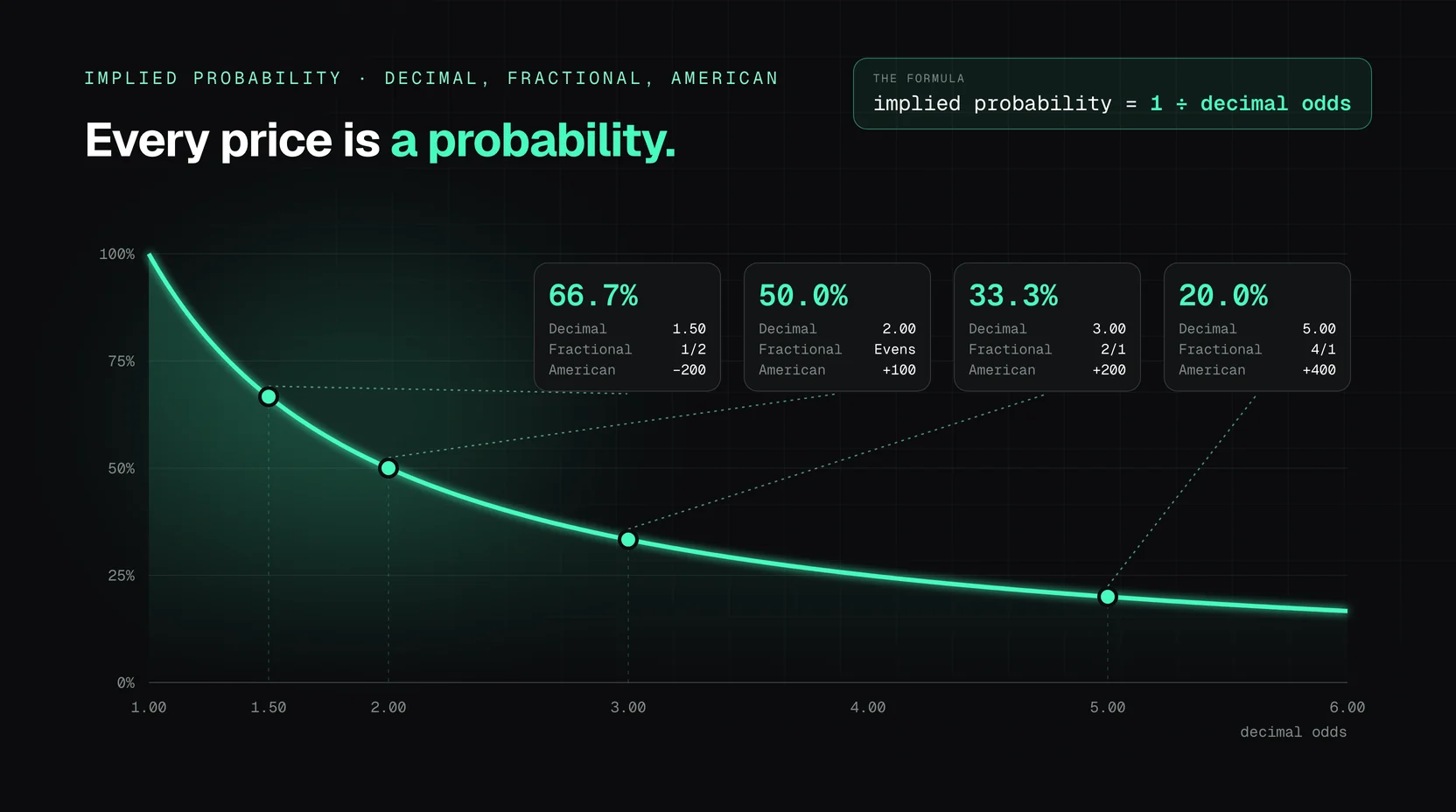
The relationship is a curve, not a straight line: odds move a lot near the long end for small changes in probability, and very little near the short end. The chart at the top of this page shows it. For quick lookups:
| Decimal | Fractional | American | Implied probability |
|---|---|---|---|
| 1.25 | 1/4 | −400 | 80.0% |
| 1.50 | 1/2 | −200 | 66.7% |
| 1.80 | 4/5 | −125 | 55.6% |
| 1.91 | 10/11 | −110 | 52.4% |
| 2.00 | 1/1 (evens) | +100 | 50.0% |
| 2.50 | 3/2 | +150 | 40.0% |
| 3.00 | 2/1 | +200 | 33.3% |
| 4.00 | 3/1 | +300 | 25.0% |
| 5.00 | 4/1 | +400 | 20.0% |
| 10.00 | 9/1 | +900 | 10.0% |
1.91 is rounded from 1.909, the exact decimal for 10/11 and −110.
From probability back to odds
The conversion works both ways. Decimal odds = 1 ÷ probability, so a 40% chance is worth 2.50. This is how fair odds are made: estimate the probability, then invert it.
For American odds: if the probability p is below 50%, the price is +(100 ÷ p − 100); at 40% that is +150. If p is above 50%, the price is −(100 × p ÷ (1 − p)); at 60% that is −150.
Implied probability vs true probability
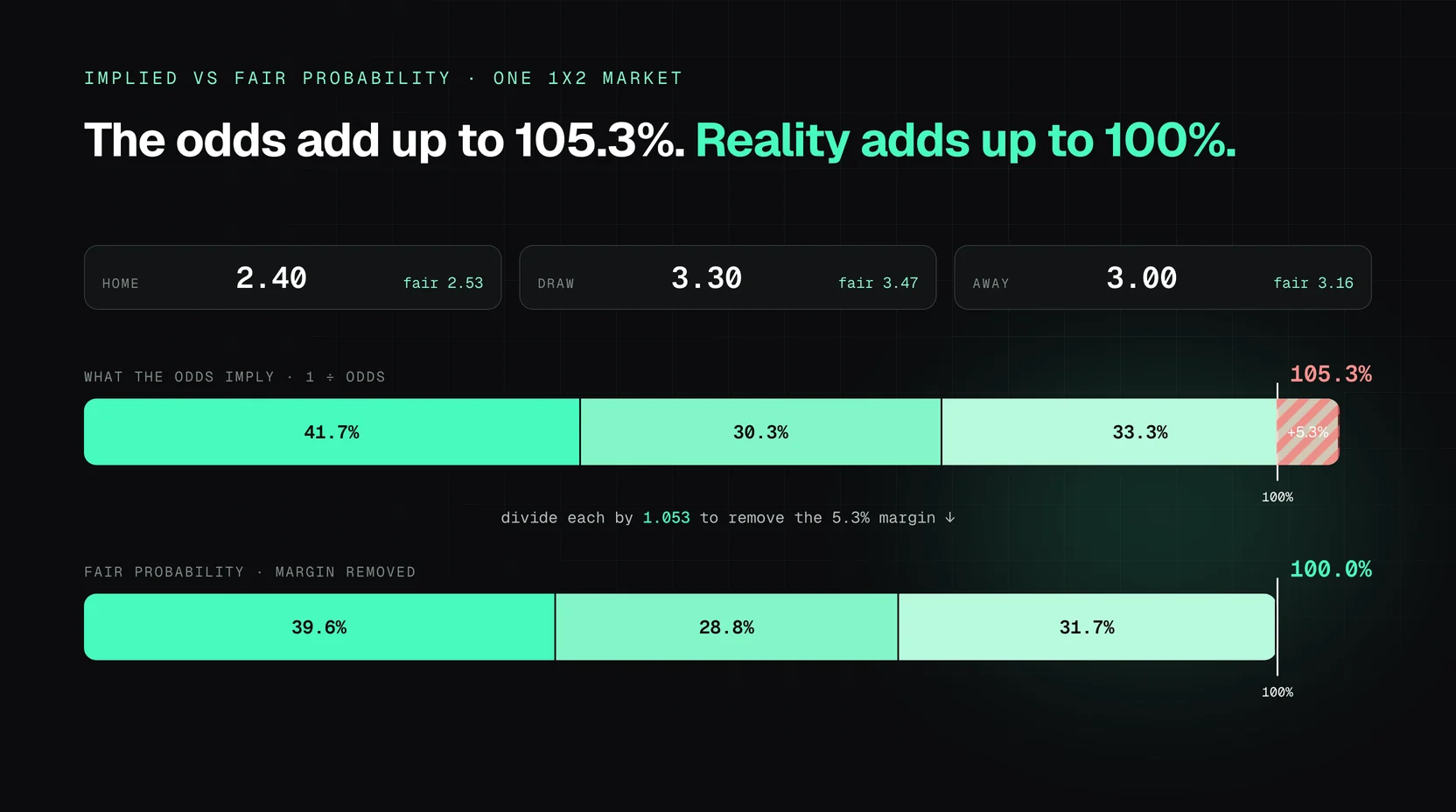
Add up the implied probabilities of every outcome in a market and you will almost always get more than 100%. In the example above, 2.40 / 3.30 / 3.00 gives 41.67% + 30.30% + 33.33% = 105.3%. The extra 5.3% is the overround, the bookmaker’s margin.
To estimate the true probabilities, remove the margin. The simplest way is to divide each implied probability by the total: 39.57%, 28.78% and 31.65%, which add up to 100% again. Those are fair odds of 2.53, 3.47 and 3.16.
Proportional removal is only one method, and a soft bookmaker’s own prices are only one estimate. Value bettors usually take the fair probability from a sharp bookmaker instead. Read How to remove the bookmaker margin and Sharp vs soft bookmakers.
Using implied probability to find value
Compare the implied probability of a price with your estimate of the true probability. If the true chance is higher than the implied one, the bet has positive expected value: EV = odds × true probability − 1.
Example: a price of 2.53 implies 39.5%. If your fair probability is 42%, the expected value is 2.53 × 0.42 − 1 = +6.3%. If it is 38%, the bet is worth −3.9% and you should leave it.
The full method is in What is value betting? and How to find value bets.
An implied probability calculator in Python
Two small functions: one converts any odds format to implied probability, the other removes the margin from a complete market.
def implied_probability(odds, fmt="decimal"):
    """Implied probability (0-1) from decimal, American or fractional odds."""
    if fmt == "decimal":
        return 1 / odds
    if fmt == "american":
        return 100 / (odds + 100) if odds > 0 else -odds / (-odds + 100)
    if fmt == "fractional":
        num, den = map(int, odds.split("/"))
        return den / (num + den)
    raise ValueError(fmt)

def fair_probabilities(decimal_odds):
    """Remove the margin proportionally so a complete market adds up to 100%."""
    implied = [1 / o for o in decimal_odds]
    return [p / sum(implied) for p in implied]

print(round(implied_probability(2.50), 4))                    # 0.4
print(round(implied_probability(-110, "american"), 4))        # 0.5238
print(round(implied_probability("5/2", "fractional"), 4))     # 0.2857
print([round(p, 3) for p in fair_probabilities([2.40, 3.30, 3.00])])   # [0.396, 0.288, 0.317]
Frequently asked questions
How do you calculate implied probability?
Divide 1 by the decimal odds. Odds of 2.50 give 1 ÷ 2.50 = 40%. For fractional odds a/b use b ÷ (a + b); for American odds see the formulas above.
What is implied probability in betting?
The chance of an outcome that the odds suggest, including the bookmaker’s margin. It is also the win rate you need to break even at that price.
What does −110 mean in implied probability?
American odds of −110 mean you stake 110 to win 100. The implied probability is 110 ÷ 210 = 52.4%, so you need to win more than 52.4% of such bets to make a profit.
Why do implied probabilities add up to more than 100%?
Because the bookmaker builds a margin into every price. The amount above 100% is called the overround. Removing it gives the fair probabilities.
What is the difference between implied and true probability?
Implied probability comes straight from the price and includes the margin. True probability is the real chance of the outcome, which you can only estimate, usually by removing the margin from a sharp bookmaker’s price.
How do I convert probability to odds?
Decimal odds = 1 ÷ probability. A 25% chance is 4.00. For American odds below 50% use +(100 ÷ p − 100); above 50% use −(100 × p ÷ (1 − p)).
Related reading
ValueOddsAPI provides odds data, not betting advice. Betting involves risk of loss and is for adults (18+) only. If gambling stops being fun, contact your local support service, such as StopSpillet in Denmark.
Get the data into your product
Solo €899/month (personal use), Pro €1,800, Scale €4,000, Elite €8,000 and Enterprise from €13,000/month, excluding VAT. Coverage and usage rights are confirmed before activation. Missing a bookmaker? We add the sources you need, scoped and priced per project.